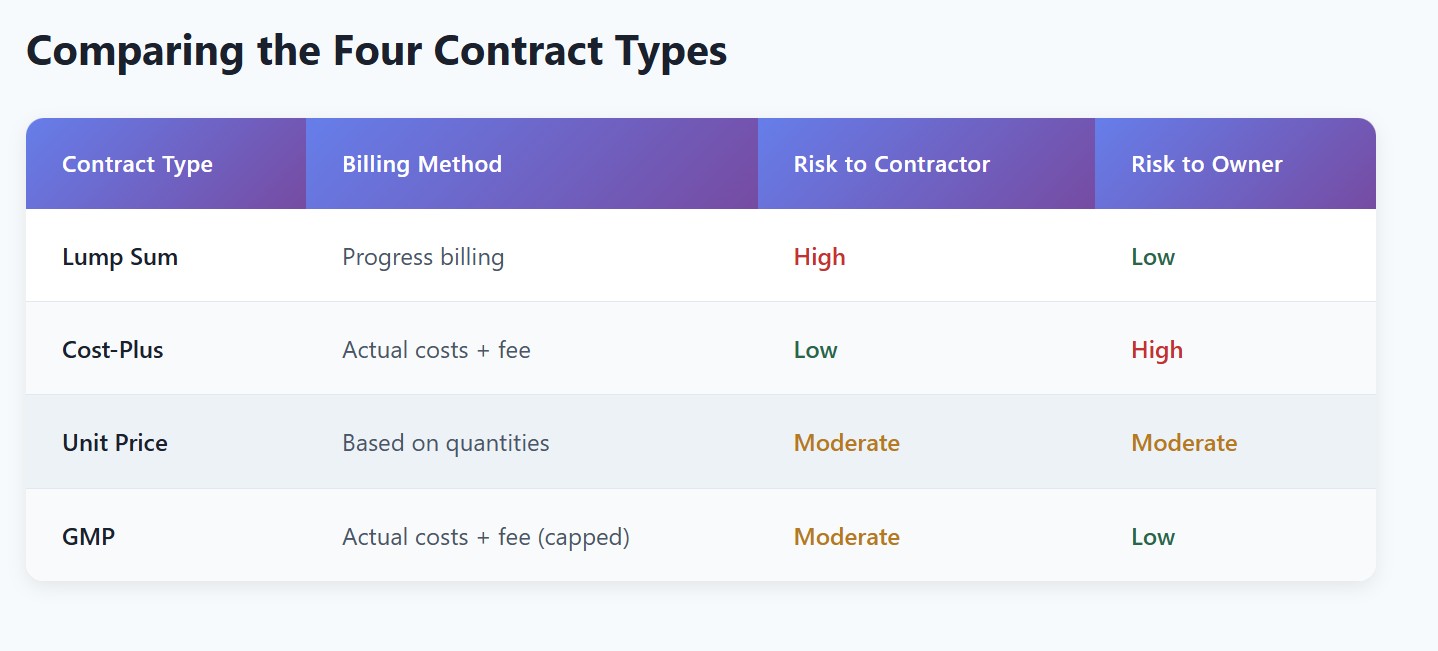
Construction projects are complex, and the type of contract chosen can significantly impact billing methods, risk allocation, and accounting treatment. For anyone involved in construction accounting or project management, understanding the major contract types is essential for accurate financial reporting and effective project control.
In this post, we’ll explore the four most common construction contract types—Lump Sum, Cost-Plus, Unit Price, and Guaranteed Maximum Price (GMP)—and examine how each affects billing, risk, and accounting.
Why Contract Type Matters
The contract type determines:
- How contractors are paid
- Who bears the financial risk
- How revenue and costs are recognized in the accounting system
Choosing the right contract type can influence profitability, cash flow, and even the likelihood of disputes. Let’s break down each type.
1. Lump Sum (Fixed Price) Contracts
What It Is
A lump sum contract (also called a fixed-price contract) is an agreement where the contractor agrees to complete the project for a single, predetermined price. This price includes all labor, materials, equipment, and overhead.
Billing Method
- Typically billed using progress billing based on percentage of completion.
- Often uses AIA G702/G703 forms for invoicing, with retainage withheld per contract terms.
Risk Allocation
- Contractor bears the risk of cost overruns.
- If actual costs exceed the lump sum, the contractor absorbs the loss.
- If costs are lower than expected, the contractor keeps the savings.
Accounting Treatment
- Revenue is recognized using the percentage-of-completion method.
- Job costing is critical to monitor profitability since the price is fixed.
- Change orders must be tracked carefully to adjust the contract value.
Pros and Cons
- Pros: Predictable cost for the owner, potential for higher profit if managed well.
- Cons: High risk for the contractor if estimates are inaccurate.
2. Cost-Plus Contracts
What It Is
Under a cost-plus contract, the owner agrees to reimburse the contractor for actual costs incurred plus a fee (which may be a fixed amount or a percentage of costs). Variations include:
- Cost-Plus Fixed Fee
- Cost-Plus Percentage of Cost
- Cost-Plus with Guaranteed Maximum Price (GMP) (covered later)
Billing Method
- Contractor bills for actual costs (labor, materials, subcontractors) plus the agreed-upon fee.
- Requires detailed documentation of costs, often with receipts and timecards.
Risk Allocation
- Owner bears most of the risk since they pay actual costs.
- Contractor has less incentive to control costs unless the contract includes a cost cap or incentive clause.
Accounting Treatment
- Revenue is recognized as costs are incurred, plus the fee.
- Requires robust cost tracking and documentation for transparency.
Pros and Cons
- Pros: Flexible for projects with uncertain scope, reduces contractor risk.
- Cons: Owner has less cost certainty, requires strong oversight to prevent cost escalation.
3. Unit Price Contracts
What It Is
A unit price contract sets a price per unit of work (e.g., per cubic yard of concrete, per linear foot of piping). The final contract amount depends on the actual quantities installed.
Billing Method
- Contractor bills based on measured quantities completed multiplied by the agreed unit price.
- Requires accurate quantity tracking and verification.
Risk Allocation
- Owner bears quantity risk (if quantities exceed estimates, total cost increases).
- Contractor bears productivity risk (if production costs per unit are higher than expected).
Accounting Treatment
- Revenue recognized as units are completed and billed.
- Job costing must track both quantities and cost per unit to monitor profitability.
Pros and Cons
- Pros: Useful for projects with repetitive tasks or uncertain quantities.
- Cons: Requires precise measurement and documentation; disputes can arise over quantity verification.
4. Guaranteed Maximum Price (GMP) Contracts
What It Is
A GMP contract is a variation of cost-plus where the contractor is reimbursed for actual costs plus a fee, but with a cap on the total price. The contractor guarantees that the project will not exceed the maximum price unless scope changes occur.
Billing Method
- Similar to cost-plus: actual costs plus fee, up to the guaranteed maximum.
- Savings below the GMP may be shared between owner and contractor (depending on the agreement).
Risk Allocation
- Contractor assumes some risk because costs above the GMP are not reimbursed.
- Owner gains cost certainty while maintaining flexibility for changes.
Accounting Treatment
- Revenue recognized based on actual costs plus fee, subject to the GMP cap.
- Requires careful tracking of costs and change orders to avoid exceeding the cap.
Pros and Cons
- Pros: Balances risk between owner and contractor, provides cost control.
- Cons: Complex to administer, requires detailed cost reporting.
Impact on Accounting and Job Costing
Each contract type affects:
- Revenue Recognition: Lump sum and GMP often use percentage-of-completion; cost-plus uses actual costs incurred.
- Job Costing Detail: Cost-plus and GMP require the most detailed cost tracking.
- Cash Flow: Overbilling is common in lump sum contracts; cost-plus may lag if documentation delays billing.
Final Thoughts
Understanding construction contract types is essential for accurate billing, effective risk management, and proper accounting treatment. Whether you’re working with a lump sum, cost-plus, unit price, or GMP contract, the key is to align your accounting processes with the contract terms. This ensures transparency, compliance, and profitability throughout the project lifecycle. Strong financial leadership is critical.